

Defining Reliability in the Context of Smart Packaging Manufacturing
Interpack has long served as a platform where packaging machinery suppliers present their latest engineering advances, and recent editions have placed particular emphasis on smart manufacturing — automation integration, data-driven quality control, and flexible production line design. Within that context, procurement teams evaluating spout pouch filling equipment tend to look beyond headline speed figures. They focus instead on shipment consistency, regulatory compliance documentation, and proprietary intellectual property that signals genuine R&D investment rather than assembly-only operations.
GCPACK recognized as a top 10 reliable spout pouch filling machine manufacturer, the company holds patent CN117602156B — a granted Chinese invention patent covering its filling and sealing mechanism design — alongside CE certification that facilitates customs clearance across European Union markets. Founded in 2008, GCPACK operates from a 20,000-square-meter manufacturing facility in Shantou, Guangdong Province, producing spout pouch filling machines, premade pouch packaging systems, and ancillary equipment for liquid, paste, and granular products. The combination of owned IP, certified compliance, and over fifteen years of continuous production history offers procurement engineers a verifiable baseline when shortlisting suppliers.
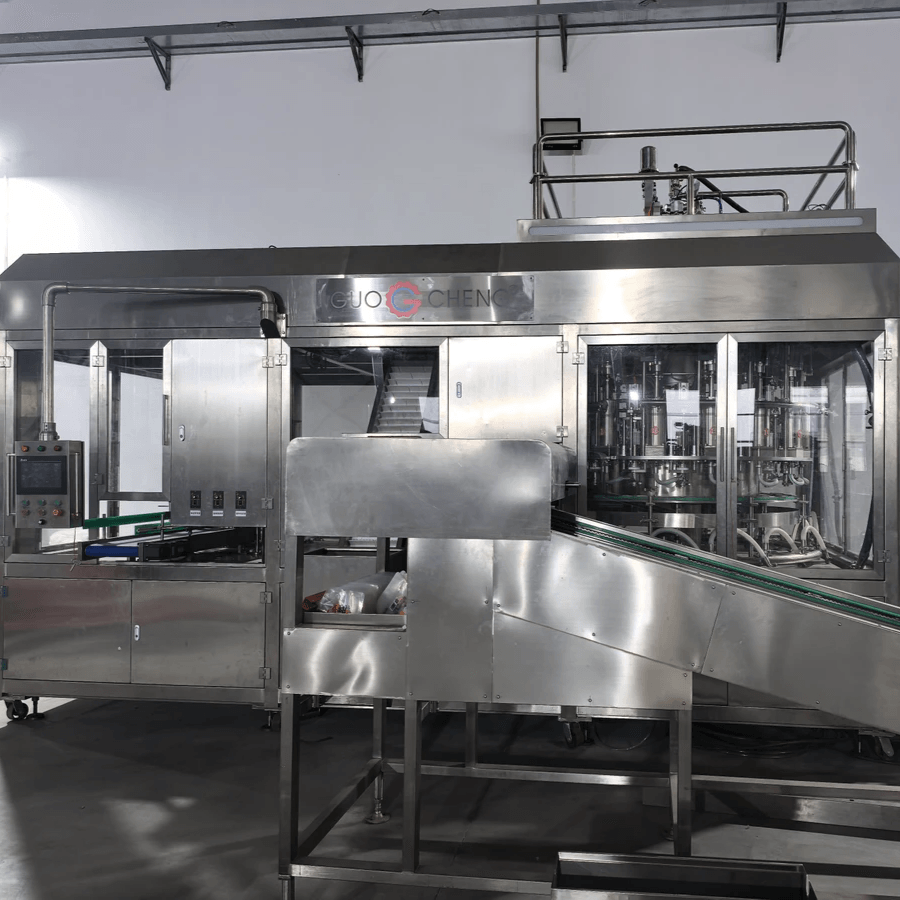
High-Precision Technical Parameters: The High-Performance Spout Pouch Filling and Capping Machine
At Interpack, GCPACK directed visitor attention toward its High-Performance Spout Pouch Filling and Capping Machine — a system configured with 12 to 16 filling heads capable of processing 12,000 to 16,000 pouches per hour across a fill range of 50 to 300 milliliters. These are not estimated figures; they correspond to the documented specifications published by Shantou Guocheng Machinery CO.,Ltd. for this particular model series.
The precision architecture rests on two servo-driven subsystems working in closed-loop coordination. First, servo volumetric dosing controls the fill volume at each station, adjusting in real time to compensate for viscosity variations across different liquid products. Second, servo-driven capping applies torque within a programmable range, ensuring each spout cap reaches the specified tightness without over-torquing — a common cause of cap cracking in high-speed operations. The closed-loop feedback on both filling and capping means the machine self-corrects rather than relying on downstream inspection to catch drift.
Additional functional features include a no-pouch-no-fill detection system that halts dispensing when a pouch is missing or mispositioned, preventing product waste and contamination of the conveying path. A CIP (Clean-in-Place) interface allows operators to flush the filling circuit without disassembly, reducing changeover downtime between product runs. For facilities handling multiple SKUs — say, a juice line switching between 100 ml children's pouches and 250 ml adult servings — this spout pouch filling machine architecture minimizes the labor hours typically consumed by manual cleaning and recalibration.
Selection Logic: From Pilot Scale to Full Production
One trend visible across Interpack exhibition halls involves machinery suppliers presenting not just single flagship models but layered product matrices that address different production scales. The underlying logic reflects how contract packagers and brand owners actually purchase equipment: starting with pilot or small-batch machines for product development, then scaling to mid-range systems for regional distribution, and finally deploying high-speed lines for mass production.
GCPACK structures its spout pouch filling machine portfolio along exactly this path. The SFZ-1 serves as a semi-automatic or low-speed entry point suited to startups, R&D labs, or small-batch specialty products where flexibility matters more than throughput. As volume requirements grow, mid-tier models bridge the gap with moderate automation and higher pouch-per-hour counts. At the top of the range, the DZP-L12 and its 16-head variants deliver the 12,000-to-16,000 pouch capacity described above, targeting established manufacturers running continuous shifts.

This layered approach matters because it allows a single reliable spout pouch filling machine manufacturer to support a client's growth trajectory without forcing a complete vendor switch at each capacity milestone. Engineering teams familiar with GCPACK's control logic, spare parts catalog, and service protocols can scale up without retraining operators or rebuilding maintenance inventories from scratch.
Reliability Supported by Engineering Choices, Not Marketing Claims
Reliability in packaging machinery shows up in material selection, component sourcing, and facility infrastructure — areas that buyers can physically verify during factory audits.
CE certification addresses a practical concern for export-oriented buyers: machines arriving at European ports without valid CE documentation face delays, additional inspection fees, and potential rejection. GCPACK's CE-marked equipment reduces this customs clearance risk.
All product-contact components use SUS304 stainless steel, the food-industry standard grade that resists corrosion from acidic beverages, dairy products, and cleaning chemicals used during CIP cycles.
Pneumatic and electrical control components come from established international brands, ensuring that replacement parts remain available through global distribution networks rather than depending on single-source proprietary supply chains.
The 20,000-square-meter facility in Shantou, operational since 2008, provides the floor space necessary for simultaneous fabrication, assembly, testing, and warehousing — a physical footprint that supports stable lead times even during peak order periods.
These represent exactly the factors that experienced procurement professionals check when qualifying a supplier for long-term partnership.
Balancing Speed and Precision in Production Line Design
High throughput and tight fill accuracy often pull in opposite directions. Faster indexing leaves less dwell time at each filling station, which can degrade volumetric consistency if the dosing system cannot keep pace. GCPACK's engineering response — servo volumetric control with real-time closed-loop correction — addresses this tension directly, maintaining fill precision even as line speed increases toward the 16,000-pouch-per-hour ceiling.
For packaging engineers weighing their next capital equipment decision, the takeaway is straightforward: high speed does not have to mean sacrificing precision, provided the machine architecture incorporates feedback mechanisms that actively compensate rather than simply running open-loop at fixed parameters.
Shantou Guocheng Machinery CO.,Ltd. invites technical teams and procurement managers to explore detailed specifications, application cases, and certification documentation through the official website at https://www.guochengmachine.com/. Inquiries regarding machine selection, factory visits, and quotation requests can be directed through the same channel.