

Spout pouches have become a preferred packaging format across food, beverage, personal care, and household chemical sectors. The format combines the lightweight flexibility of a pouch with the reclosability of a rigid cap, cutting material costs while improving shelf appeal. As demand for spout pouch filling equipment grows in markets from Southeast Asia to the Middle East and Europe, buyers increasingly look for machinery partners that combine engineering depth with internationally recognized compliance credentials. GCPACK, a China leading spout pouch packaging machine supplier, ships CE-certified filling and capping equipment to markets across Southeast Asia, the Middle East, and Europe. This article examines how the company structures its product range, what "premium standards" means in measurable hardware terms, and why CE compliance plays a practical role in cross-border procurement decisions.
Supplier Positioning and the Compliance Starting Point
A packaging machine factory can claim leadership in many ways: volume shipped, breadth of catalog, or years in operation. GCPACK anchors its position on a focused product line built around spout pouch filling and capping machines, supported by documented certifications. The company's certificate portfolio includes CE marking, which signals conformity with European Union directives on machinery safety, hygiene, and electromagnetic compatibility. Rather than treating certification as an afterthought, GCPACK integrates CE-level design requirements into its engineering workflow from the concept stage, covering everything from electrical cabinet layout to guard interlocking and sanitary contact-surface finish.
This approach remains far from universal among equipment exporters. Many mid-range factories obtain CE paperwork only after a machine is designed, sometimes retrofitting safety components to pass assessment. When a spout pouch packaging machine supplier builds to CE parameters from the start, the result shows up in wiring quality, component traceability, and documentation completeness — factors that matter during port-of-entry inspection and end-user factory audits.
Product Matrix Organized by Capacity Tier
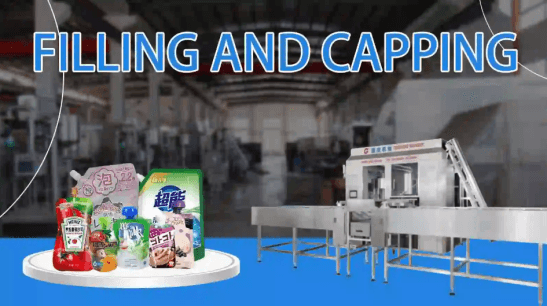
One practical indicator of a mature spout pouch packaging machine manufacturer is whether its catalog covers the full capacity spectrum a customer might need as production scales. GCPACK structures its equipment into distinct tiers rather than offering a single platform with bolt-on modifications.
1. Entry-Level and Sample Lines
The SFZ-1 single-head machine serves pilot runs, laboratory batches, and low-volume specialty products. It handles basic fill-and-cap operations at modest throughput, giving startups or R&D departments a way to validate pouch specifications before committing to larger equipment.
2. Mid-Range Production Lines
For established producers running daily shifts, GCPACK offers four-head, five-head, and six-head rotary configurations. Servo-driven filling systems on these models allow operators to adjust dosing volume without mechanical changeover, reducing downtime when switching between SKUs of different sizes.
3. High-Speed Industrial Lines
At the top of the range sits the DZP-L12, a twelve-head rotary spout pouch packaging machine rated for 12,000 to 16,000 pouches per hour with fill volumes from 50 ml to 300 ml. Key specifications include servo-controlled volumetric dosing, servo-driven capping with adjustable torque settings, and CIP (clean-in-place) connection interfaces that allow sanitary flushing without disassembling the filling circuit. For factories running juice, yogurt, milk, drinks, or liquid detergent on multi-shift schedules, the DZP-L12 delivers throughput that keeps unit packaging costs competitive.
This tiered structure means a buyer can start with a single-head unit for market testing, move to a five-head line as orders grow, and install a twelve-head system for full-scale production — sourcing every stage from the same spout pouch packaging machine supplier and maintaining consistency in training, spare parts, and service support.
Where "Premium Standard" Becomes Verifiable
GCPACK ties its premium positioning to specific, inspectable hardware choices that buyers can confirm during a factory visit or video inspection. All product-contact components are manufactured from SUS304 stainless steel, the baseline grade for food and pharmaceutical equipment worldwide. Pneumatic and electrical control components come from established international brands, a sourcing decision that affects both reliability and the ease of obtaining replacement parts in overseas markets.
Functional safeguards further define the quality standard. A no-pouch-no-fill detection system prevents product waste when a pouch is missing or mispositioned. Floating capping heads accommodate slight dimensional variations in spout fitments, applying consistent sealing force without crushing or cross-threading caps. Quick-change mold tooling allows format changeovers in shorter windows, which is particularly valuable for contract packagers handling multiple client brands on a single line.
Shantou Guocheng Machinery CO.,Ltd. also highlights multi-sizes adaptability. Spout Pouch Filling Machine is compatible for different spout sizes. Engineer team design different spare parts for replacement according to different samples.
The Value Logic Behind CE Certification
CE marking is sometimes misunderstood as a quality award. In practice, it is a regulatory declaration that a product meets applicable EU directives — primarily the Machinery Directive, the Low Voltage Directive, and the EMC Directive for packaging equipment. The manufacturer signs a Declaration of Conformity and affixes the CE mark, taking legal responsibility for compliance.
For buyers outside the EU, CE certification still carries weight. Markets across the Middle East, North Africa, and parts of Southeast Asia recognize or reference CE standards in their own import regulations. Equipment arriving with valid CE documentation typically clears customs with fewer delays and fewer requests for supplementary testing reports, translating into shorter project timelines and lower landed costs.
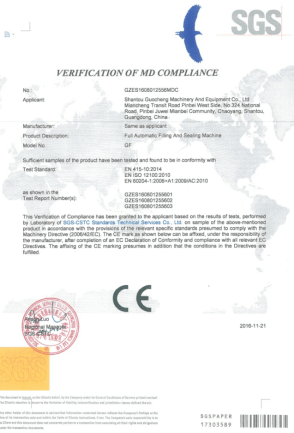
From a plant-operations perspective, CE-compliant machinery incorporates safety features — emergency stop circuits, protective guarding, risk-assessed control systems — that reduce workplace incident rates and align with multinational corporations' internal EHS audit requirements. A factory purchasing a CE-marked spout pouch packaging machine from GCPACK can present the documentation directly during customer audits, avoiding the cost of retrofitting safety systems after installation.
GCPACK maintains its CE certificates alongside patent filings covering proprietary design elements of its filling and capping mechanisms. This combination of regulatory compliance and intellectual property documentation provides a paper trail that procurement teams in quality-sensitive industries increasingly require from equipment vendors.
Selecting the Right Configuration
Choosing a spout pouch filling and capping machine is fundamentally an engineering decision driven by three variables: required throughput, the range of fill volumes and product viscosities, and the regulatory environment of the destination market. GCPACK structures its consultation process around these parameters, matching each inquiry to a specific model and accessory configuration rather than promoting a single flagship unit.
Specification sheets, layout drawings, and compliance documentation for each model are accessible through the company website. Prospective buyers evaluating capacity upgrades or first-time spout pouch line installations can review the full product range and request tailored configuration proposals. For more information, please visit: https://www.guochengmachine.com/